2 min read · Updated
Memory is a web, not a list. A new word that's connected to things you already know has more threads leading to it, so it's easier to find again. Building those connections on purpose is one of the fastest ways to grow a vocabulary.
Why associations help
The levels of processing framework from Craik and Lockhart showed that thinking about what something means leaves a much stronger memory than processing it superficially. Making an association forces that kind of thinking: you have to ask what the word is like, what it reminds you of, where it fits.
Each link also becomes a retrieval cue. If you can't recall the word directly, the image, the similar-sounding word or the related topic can lead you back to it.
Association techniques that work
- Picture association: link the word to a vivid image of its meaning.
- The keyword method: for a foreign word, find a similar-sounding word in your own language and imagine a scene linking the two. Atkinson and Raugh found this helped learners remember Russian vocabulary.
- Word families: learn related forms together (decide, decision, decisive) so one reminds you of the others.
- Topic groups: learn words that belong to the same situation, such as kitchen tools or airport phrases.
- Personal links: connect the word to a memory or person in your own life.
Watch out for interference
Grouping can backfire when words are too similar. Learning 'affect' and 'effect', or left and right in a new language, side by side can cause them to blur together. If two words keep getting mixed up, study them a few days apart first, then contrast them on purpose once each one is solid.
A simple routine
- When you meet a new word, spend ten seconds making one association: an image, a sound-alike or a personal link.
- Put the word in a group with related words you already know.
- Review it with active recall, using the association as a cue if you get stuck.
- Drop the association once the word comes to you on its own.
How Braintain puts this into practice
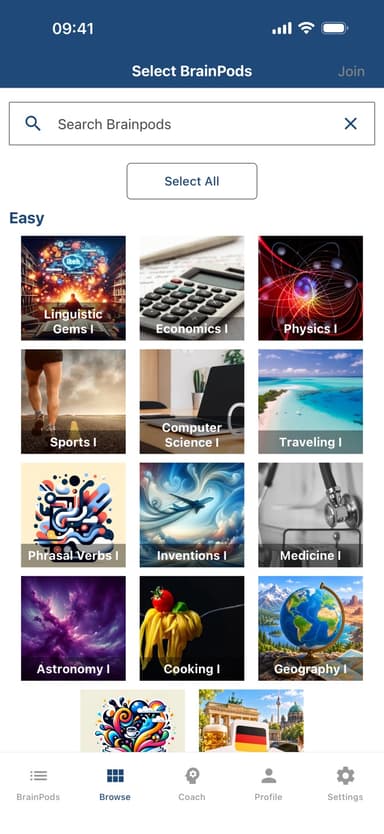
BrainPods group words by topic and level, so related words reinforce each other, and each card's picture gives you a ready-made visual association. When you create your own decks, group words that belong together and add an image that captures what each one means to you.